

SS 304 vs 316 vs 316L: Which Stainless Steel Grade Is Right for Your Industry?

erametssteel.
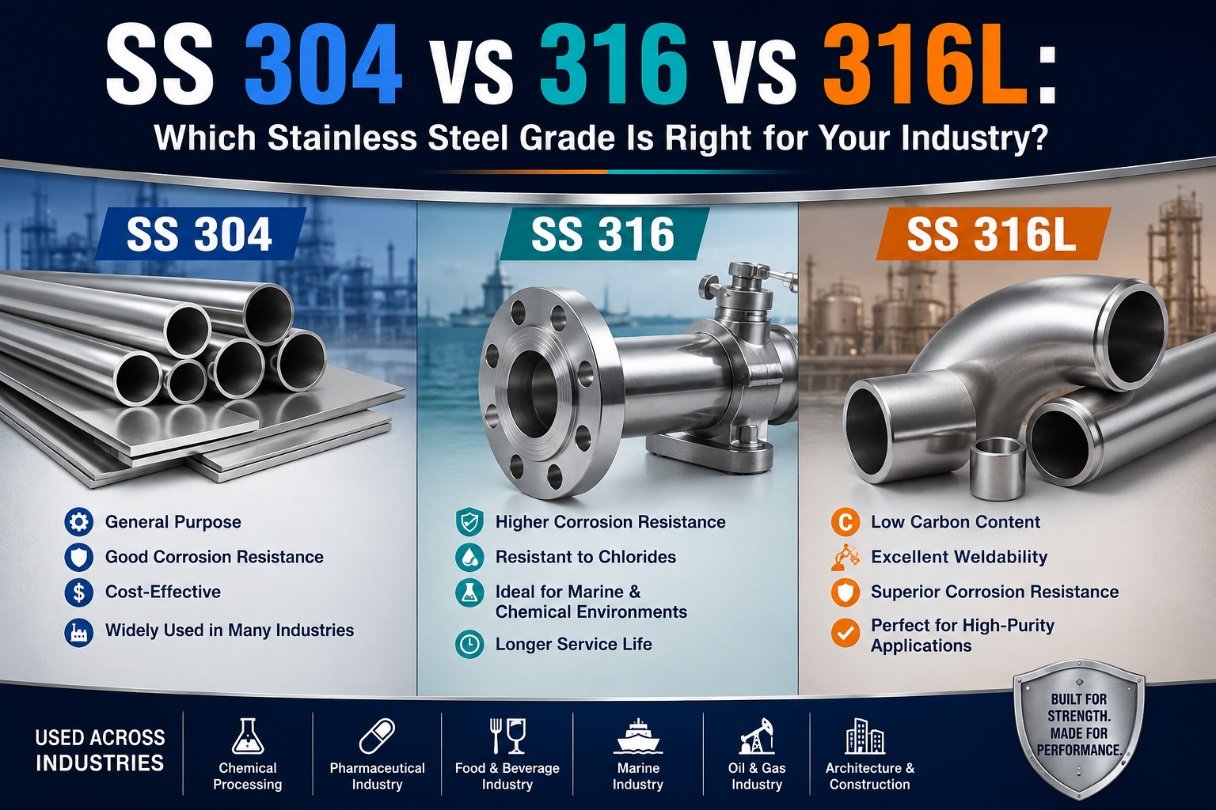
Choosing the right stainless steel grade is one of the most important decisions in any industrial procurement process. While 304, 316, and 316L may look similar on a spec sheet, the differences in composition translate into real differences in performance, cost, and long-term reliability. Picking the wrong grade can mean premature corrosion, weld failure, or costly downtime — picking the right one means decades of trouble-free service.
Here’s a practical breakdown of these three widely used austenitic stainless steel grades, and how to decide which one fits your application.
What is SS 304?
SS 304 is the most commonly used stainless steel grade in the world, prized for its versatility, affordability, and good general corrosion resistance. It contains roughly 18% chromium and 8% nickel, which gives it a strong balance of strength, formability, and resistance to oxidation.
Best suited for:
- Food processing and kitchen equipment
- Architectural and structural applications
- General fabrication, storage tanks, and piping
- Indoor or moderately corrosive environments
304 performs well in most everyday industrial settings but starts to struggle when exposed to chlorides, salts, or aggressive chemical environments — which is where 316 steps in.
What is SS 316?
SS 316 shares a similar base composition to 304 but adds 2–3% molybdenum. This single addition significantly improves resistance to pitting and crevice corrosion, especially in chloride-rich or marine environments.
Best suited for:
- Marine hardware and coastal construction
- Chemical processing and storage
- Pharmaceutical and medical equipment
- Oil & gas components exposed to saline or corrosive fluids
Because of its enhanced corrosion resistance, SS 316 costs more than 304, but for environments where chlorides or acids are present, it more than pays for itself in reduced maintenance and failure risk.
What is SS 316L?
SS 316L is the low-carbon version of 316. The “L” stands for “low carbon,” with carbon content capped at around 0.03% compared to 0.08% in standard 316. This lower carbon content prevents a phenomenon called carbide precipitation during welding, which can otherwise lead to intergranular corrosion near weld seams.
Best suited for:
- Heavily welded structures and pipelines
- Pharmaceutical, dairy, and beverage processing equipment
- Sanitary tubing and heat exchangers
- Any application requiring extensive fabrication or field welding
If your project involves significant welding, 316L is almost always the safer long-term choice over standard 316.
Key Differences at a Glance
| Property | SS 304 | SS 316 | SS 316L |
|---|---|---|---|
| Molybdenum content | None | 2–3% | 2–3% |
| Carbon content | ~0.08% | ~0.08% | ~0.03% |
| Corrosion resistance | Good | Excellent (chlorides) | Excellent (chlorides) |
| Weldability | Good | Good | Best (no carbide precipitation) |
| Cost | Lowest | Higher | Highest |
| Typical use | General industrial | Marine, chemical, pharma | Welded pharma, dairy, sanitary systems |
Choosing the Right Grade for Your Industry
Chemical Industries: 316 or 316L is generally preferred due to exposure to acids, solvents, and corrosive chemicals. Where welded joints are extensive, 316L reduces the risk of weld-decay corrosion.
Oil & Gas Industries: 316 is widely used for its resistance to saline environments, especially offshore and coastal installations. 316L is chosen where pipeline welding is extensive.
Pharmaceutical Industries: 316L is the industry standard due to strict hygiene requirements and heavy reliance on welded sanitary tubing and vessels.
Dairy and Beverage Industries: 316L is preferred for direct product-contact surfaces, as it resists cleaning chemicals and prevents contamination at weld points.
Sugar Industries: 304 is often sufficient for structural components, while 316 is used in areas exposed to corrosive process fluids.
General Fabrication and Architecture: 304 remains the most economical and practical choice for non-corrosive, indoor, or dry environments.
Making the Final Decision
When selecting between 304, 316, and 316L, consider three factors:
- Exposure environment — Is the material exposed to chlorides, marine air, or aggressive chemicals? If yes, move to 316 or 316L.
- Fabrication method — Will the material undergo significant welding? If yes, 316L reduces long-term corrosion risk near welds.
- Budget constraints — 304 is the most economical option; 316L carries the highest cost but offers the best combination of corrosion resistance and weldability.
A trusted stainless steel supplier can help match the right grade, form (pipes, tubes, sheets, plates, bars, or fasteners), and certification to your project’s technical and regulatory requirements ensuring long-term performance without overspending on unnecessary specifications.
FAQs
1. Is SS 316 always better than SS 304?
Not necessarily. SS 316 offers superior corrosion resistance, particularly against chlorides and marine environments, but it costs more. For dry, indoor, or low-corrosion applications, SS 304 is often the more cost-effective and perfectly adequate choice.
2. What is the main difference between SS 316 and SS 316L?
The primary difference is carbon content. SS 316L has a much lower carbon content (≤0.03%) than standard SS 316 (~0.08%), which prevents carbide precipitation during welding and reduces the risk of intergranular corrosion at weld seams.
3. Can SS 304 be used in the pharmaceutical or food industry?
SS 304 can be used for general food-grade equipment in low-corrosion settings, but most pharmaceutical, dairy, and sanitary applications require 316L due to its superior resistance to cleaning chemicals, process fluids, and its weld-friendly properties.
4. Does SS 316L cost significantly more than SS 304?
Yes, SS 316L is typically the most expensive of the three grades due to its molybdenum content and low-carbon refining process. However, the added cost is often justified by reduced maintenance, longer service life, and lower failure risk in demanding environments.