

Inconel 625 Pipe vs Inconel 600 Pipe: Key Differences Explained

erametssteel.
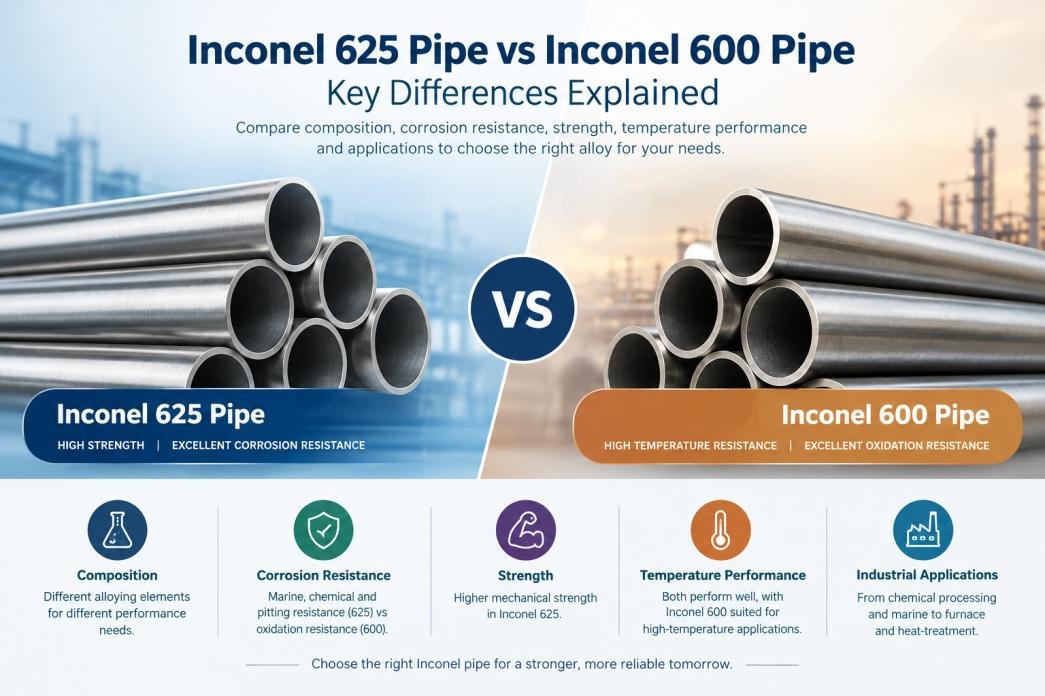
When selecting pipes for demanding industrial applications, material selection is important for achieving reliable performance, corrosion resistance, and long service life. Inconel 625 Pipe and Inconel 600 Pipe are nickel-chromium alloys commonly used in industries where conventional materials may not provide the required performance.
Although both alloys offer excellent resistance to heat and corrosion, their chemical composition, mechanical properties, and typical applications are different. Understanding these differences can help industries select the appropriate material for their specific requirements.
What Is Inconel 625 Pipe?
Inconel 625 Pipe is a nickel-chromium-molybdenum alloy with niobium. Its composition provides excellent resistance to pitting, crevice corrosion, and many corrosive environments.
Inconel 625 Pipes are commonly used in chemical processing, marine applications, aerospace equipment, oil and gas systems, and other demanding industrial environments.
The alloy is also known for its good strength and resistance to high-temperature conditions, making Inconel 625 Seamless Pipes suitable for applications where both mechanical strength and corrosion resistance are required.
What Is Inconel 600 Pipe?
Inconel 600 Pipe is a nickel-chromium alloy designed for resistance to oxidation and corrosion at elevated temperatures. It is widely used in heat-treatment equipment, chemical processing, furnace components, and other high-temperature applications.
Compared with Inconel 625, Inconel 600 has a simpler alloy composition, with nickel and chromium being its primary alloying elements.
Inconel 625 Pipe vs Inconel 600 Pipe
The major differences between Inconel 625 and Inconel 600 can be understood through their composition, corrosion resistance, strength, and applications.
1. Chemical Composition
Inconel 625 contains nickel, chromium, molybdenum, and niobium as important alloying elements. The presence of molybdenum and niobium contributes to its strength and corrosion resistance.
Inconel 600 primarily contains nickel and chromium, which provide good resistance to oxidation and various corrosive environments.
2. Corrosion Resistance
Both alloys provide good corrosion resistance, but they are used in somewhat different environments.
Inconel 625 Pipe offers strong resistance to localized corrosion, including pitting and crevice corrosion. This makes it suitable for demanding chemical and marine environments.
Inconel 600 Pipe provides excellent resistance to oxidation and many organic and inorganic compounds, particularly at elevated temperatures.
3. Strength
Inconel 625 generally provides higher mechanical strength because of its alloying elements and strengthening characteristics.
This makes Inconel 625 Pipes useful in applications where the piping system must withstand demanding mechanical and corrosive conditions.
Inconel 600 is also a strong material, but it is often selected where high-temperature oxidation resistance and general corrosion resistance are the primary requirements.
4. Temperature Performance
Both Inconel 625 and Inconel 600 can perform in elevated-temperature environments.
Inconel 600 is widely associated with high-temperature applications such as furnace components and heat-treatment equipment.
Inconel 625 is also suitable for elevated-temperature service while offering a combination of strength and corrosion resistance that is useful in demanding industrial systems.
5. Industrial Applications
Inconel 625 Pipes are commonly considered for:
- Chemical processing equipment
- Oil and gas applications
- Marine systems
- Aerospace components
- Heat exchangers
- Pollution-control equipment
- High-corrosion environments
Inconel 600 Pipes are commonly used for:
- Furnace components
- Heat-treatment equipment
- Chemical processing
- Heat exchangers
- High-temperature equipment
- Chemical and petrochemical applications
Which Inconel Pipe Should You Choose?
The choice between Inconel 625 and Inconel 600 depends on the operating environment and application requirements.
If the application requires a combination of high strength and strong resistance to localized corrosion, Inconel 625 may be considered.
For applications where oxidation resistance, high-temperature performance, and general corrosion resistance are important, Inconel 600 can be a suitable material option.
Other factors such as temperature, pressure, chemical exposure, pipe dimensions, manufacturing standard, and required mechanical properties should also be considered before selecting the material.
Why Choose Inconel 625 Pipes?
Inconel 625 Pipes are widely used for demanding applications because they offer a useful combination of corrosion resistance, mechanical strength, and high-temperature performance.
When selecting an Inconel 625 Pipe Supplier, buyers should consider product quality, required specifications, dimensions, applicable standards, testing requirements, and delivery capabilities.
Conclusion
Inconel 625 Pipe and Inconel 600 Pipe are both nickel-based alloys designed for demanding industrial applications, but they have different compositions and performance characteristics.
Inconel 625 is particularly useful where high strength and resistance to severe corrosion are important, while Inconel 600 is widely used for oxidation-resistant and high-temperature applications.
Understanding the operating conditions and technical requirements of your project is essential when selecting between these two Inconel alloys.

