

Why the Pharmaceutical Industry Relies on 316L Stainless Steel Tubing

erametssteel.
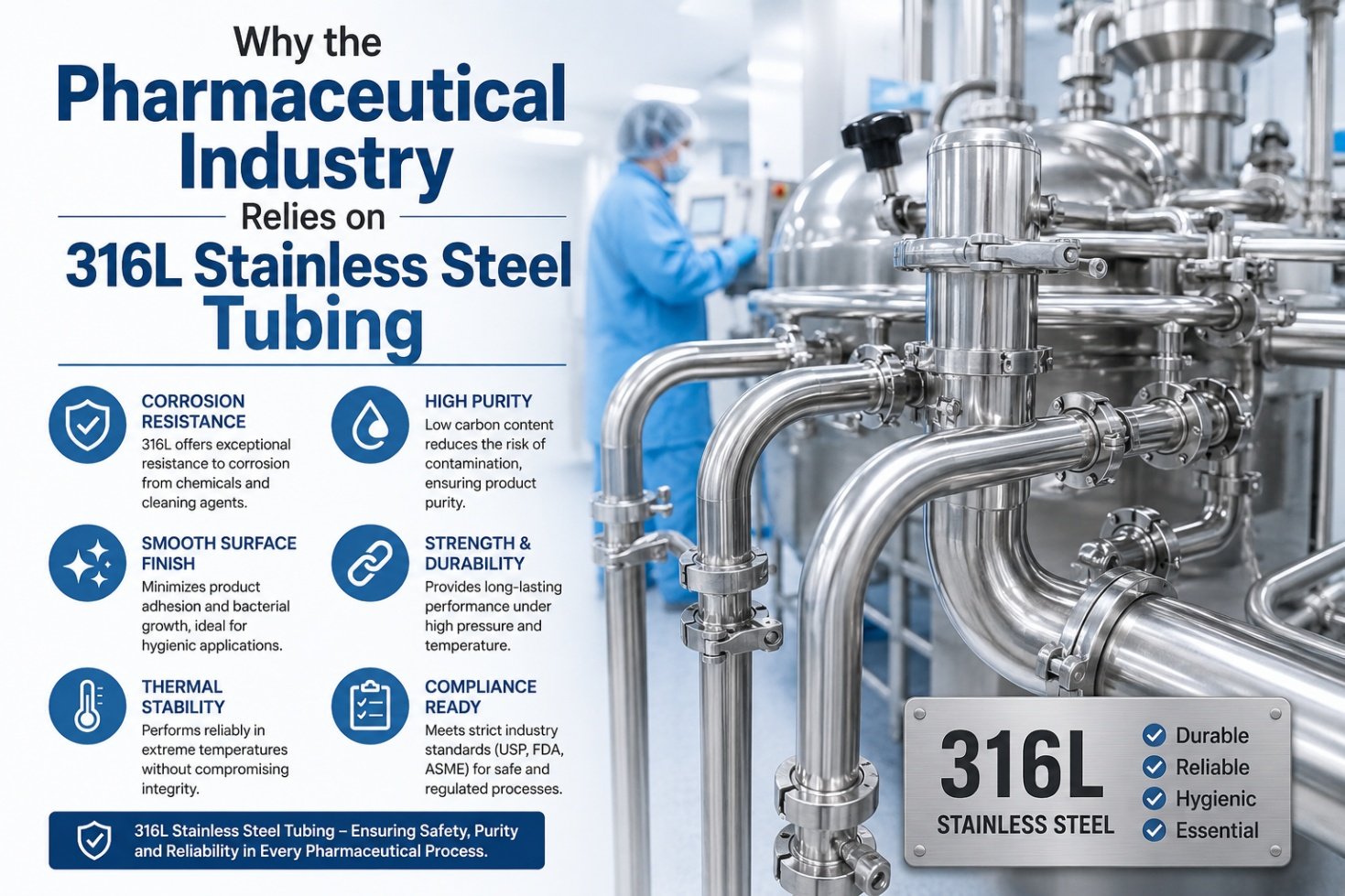
The pharmaceutical industry operates under some of the strictest quality and safety standards of any sector in the world. Every material that comes into contact with drugs, active pharmaceutical ingredients (APIs), or process fluids must meet exacting benchmarks for purity, corrosion resistance, and cleanability. Among the many materials available to engineers and procurement teams, 316L stainless steel tubing has emerged as the material of choice for critical pharmaceutical applications. Here’s a closer look at why this specific grade has become indispensable across drug manufacturing, bioprocessing, and sterile fluid handling systems.
What Makes 316L Different
316L is a low-carbon version of the widely used 316 stainless steel. The “L” stands for “low carbon,” meaning it contains a maximum carbon content of around 0.03%, compared to roughly 0.08% in standard 316. This might sound like a minor difference, but it has a significant impact on performance.
Lower carbon content reduces the risk of carbide precipitation during welding, a phenomenon known as sensitization, which can make the metal vulnerable to corrosion along weld seams. Since pharmaceutical piping systems involve extensive welding to create sterile, leak-proof networks, this resistance to weld decay is critical. It ensures that even after fabrication, the tubing retains its full corrosion-resistant properties at every joint.
Superior Corrosion Resistance
Pharmaceutical manufacturing involves a wide range of aggressive substances, including purified water, water-for-injection (WFI), cleaning agents, acids, and various solvents used in synthesis and formulation. 316L contains molybdenum, which significantly improves resistance to pitting and crevice corrosion, especially in chloride-rich environments.
This corrosion resistance isn’t just about protecting the tubing itself, it’s about protecting the product. Any degradation of the tubing surface can introduce metal ions or particulates into the process stream, compromising drug purity and patient safety. 316L’s stability under repeated exposure to cleaning-in-place (CIP) and sterilization-in-place (SIP) cycles makes it uniquely suited to this demanding environment.
Hygienic Design and Surface Finish
Pharmaceutical tubing isn’t just about the base material surface finish plays an equally important role. 316L tubing is typically supplied with electropolished interior surfaces, achieving extremely low roughness values (often below 0.4 microns Ra). This smooth finish minimizes microbial adhesion, prevents product buildup, and ensures that every batch can be cleaned and validated to pharmaceutical-grade standards.
Combined with sanitary fittings and orbital welding techniques, 316L tubing systems can be constructed with minimal crevices or dead legs areas where bacteria could otherwise accumulate. This is essential for compliance with cGMP (current Good Manufacturing Practices) and other regulatory frameworks that govern sterile drug production.
Compliance with International Standards
Global pharmaceutical operations require materials that meet recognized international specifications. 316L tubing manufactured to standards such as ASTM A270 TP316L is specifically designed for sanitary and hygienic applications, including dairy, food, beverage, and pharmaceutical processing. These standards define strict requirements for surface finish, dimensional tolerance, and weld integrity, giving manufacturers confidence that the tubing will perform reliably in validated, regulated environments.
Durability Under Repeated Sterilization
Pharmaceutical systems are subjected to frequent, repeated sterilization cycles often involving high temperatures, steam, or chemical sterilants. 316L’s excellent resistance to thermal fatigue and its stable mechanical properties across a wide temperature range mean it can withstand thousands of sterilization cycles without significant degradation. This durability translates directly into lower long-term maintenance costs and reduced risk of unplanned downtime.
Supporting Biopharma and Injectable Manufacturing
As biopharmaceutical production and injectable drug manufacturing continue to expand, the demand for ultra-clean fluid transfer systems has grown accordingly. 316L tubing is widely used in bioreactor piping, WFI distribution loops, buffer preparation systems, and single-use/hybrid processing setups. Its combination of strength, formability, and corrosion resistance makes it adaptable to both traditional stainless steel systems and hybrid configurations involving single-use technology.
The Bottom Line
For pharmaceutical manufacturers, tubing isn’t just a structural component — it’s a critical control point for product quality and patient safety. 316L stainless steel tubing delivers the corrosion resistance, hygienic surface finish, weldability, and regulatory compliance that this industry demands. As pharmaceutical production scales up globally and regulatory scrutiny intensifies, reliable, certified 316L tubing from trusted suppliers remains a cornerstone of safe, compliant drug manufacturing.
Frequently Asked Questions
1. What is the difference between 316 and 316L stainless steel for pharmaceutical use?
The key difference is carbon content. 316L has a much lower carbon content than standard 316, which prevents carbide precipitation during welding. Since pharmaceutical systems rely heavily on welded joints, 316L is preferred because it maintains corrosion resistance even after fabrication.
2. Why is electropolishing important for pharmaceutical tubing?
Electropolishing creates an extremely smooth, low-roughness interior surface that reduces microbial adhesion and product residue buildup. This makes cleaning and sterilization more effective and helps pharmaceutical companies meet cGMP and validation requirements.
3. Can 316L tubing withstand repeated steam sterilization?
Yes. 316L stainless steel maintains its mechanical strength and corrosion resistance across repeated high-temperature sterilization cycles, including steam-in-place (SIP) processes, making it suitable for long-term use in sterile manufacturing environments.
4. What standards should pharmaceutical-grade 316L tubing meet?
Pharmaceutical tubing is commonly manufactured to standards such as ASTM A270 TP316L, which specifies requirements for sanitary applications, including surface finish, dimensional accuracy, and weld quality suitable for food, dairy, and pharmaceutical industries.