

316 vs 316L Stainless Steel Sheets & Plates: Key Differences and Selection Guide

erametssteel.
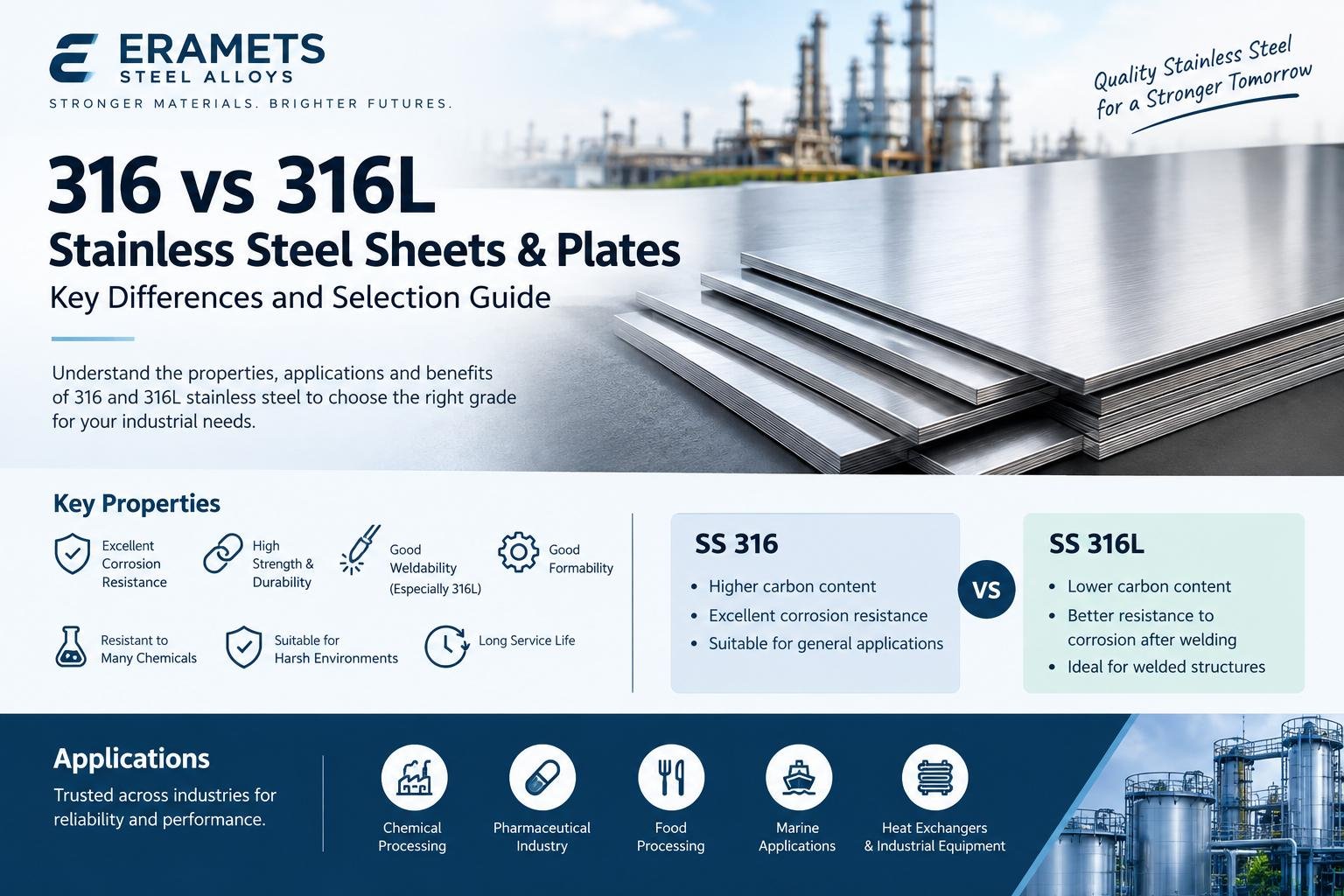
Stainless steel is widely used across industries because of its strength, corrosion resistance, durability, and versatility. Among the different stainless steel grades, Stainless Steel 316 and 316L Sheets & Plates are especially popular for applications that require excellent corrosion resistance and reliable performance.
Although SS 316 and SS 316L are very similar grades, there are some important differences between them. Understanding these differences can help industries select the right material for their specific requirements.
What Is Stainless Steel 316?
Stainless Steel 316 is an austenitic stainless steel grade containing chromium, nickel, and molybdenum. The addition of molybdenum improves its resistance to corrosion, particularly in environments exposed to chlorides and other corrosive substances.
SS 316 Sheets & Plates are commonly used in chemical processing, marine equipment, food processing, pharmaceutical equipment, and other industrial applications where good corrosion resistance is required.
What Is Stainless Steel 316L?
Stainless Steel 316L is the low-carbon version of Stainless Steel 316. The “L” stands for “Low Carbon.” Its lower carbon content makes it particularly suitable for welding applications because it helps reduce the risk of corrosion around welded areas.
They are widely used in industries where corrosion resistance, fabrication, and welding performance are important.
316 vs 316L Stainless Steel: Key Difference
The main difference between 316 and 316L stainless steel is their carbon content.
SS 316 has a slightly higher carbon content, while SS 316L has a lower carbon content. Because of its lower carbon level, 316L offers better resistance to corrosion that can occur after welding.
For applications involving extensive welding or fabrication, 316L Stainless Steel Sheets & Plates are often preferred.
Properties of Stainless Steel 316 / 316L Sheets & Plates
Both grades offer several useful properties, including:
- Excellent corrosion resistance
- Good resistance to chloride environments
- Good strength and durability
- Excellent weldability, particularly for 316L
- Good formability
- Resistance to many chemicals
- Suitable for demanding industrial environments
- Long service life with proper application and maintenance
Applications of SS 316 and 316L Sheets & Plates
Stainless Steel 316 and 316L Sheets & Plates are used in many industries because of their corrosion resistance and durability.
Chemical Processing
These stainless steel grades are used for equipment and components exposed to various chemicals and corrosive environments.
Pharmaceutical Industry
316L stainless steel is widely preferred for pharmaceutical equipment where cleanliness, corrosion resistance, and hygienic surfaces are important.
Food Processing
SS 316 and 316L can be used in food processing equipment and components where corrosion resistance and durability are required.
Marine Applications
The improved corrosion resistance of 316 and 316L makes them suitable for various marine and coastal applications.
Heat Exchangers and Industrial Equipment
These grades can also be used for industrial equipment, processing systems, and components that require good corrosion resistance and reliable performance.
Benefits of Stainless Steel 316 / 316L Sheets & Plates
Choosing the right stainless steel grade can improve the performance and service life of industrial components. Some key benefits include:
High Corrosion Resistance
316 and 316L provide better corrosion resistance than many commonly used stainless steel grades, especially in chloride-containing environments.
Excellent Durability
Both grades offer good mechanical properties and can withstand demanding industrial conditions.
Good Fabrication Properties
316L is particularly suitable for welded structures because of its low carbon content.
Versatile Applications
These sheets and plates can be used across chemical, pharmaceutical, food processing, marine, and industrial applications.
How to Choose Between 316 and 316L?
The selection between 316 and 316L depends on the application’s operating conditions and fabrication requirements.
If the application involves significant welding and requires improved resistance to corrosion around welded areas, 316L Stainless Steel Sheets & Plates can be a suitable choice.
For applications where welding is less critical and the required material properties are met by the standard 316 grade.
Other factors such as sheet or plate thickness, dimensions, surface finish, operating environment, and project specifications should also be considered before selecting the material.
Stainless Steel 316 / 316L Sheets & Plates from Eramets Steel
At Eramets Steel Alloys, we supply Stainless Steel 316 / 316L Sheets & Plates for different industrial requirements. Our products are available in different sizes and specifications to meet project-specific needs.
With a focus on quality and reliable supply, Eramets Steel Alloys provides stainless steel products for industries requiring corrosion resistance, durability, and consistent performance.
Conclusion
Stainless Steel 316 and 316L are both reliable materials for applications requiring excellent corrosion resistance and durability. The primary difference is their carbon content, with 316L having a lower carbon content and offering advantages for welded applications.
Understanding the differences between Stainless Steel 316 / 316L Sheets & Plates can help buyers, engineers, and industries select the appropriate grade according to their application, fabrication requirements, and operating environment.

